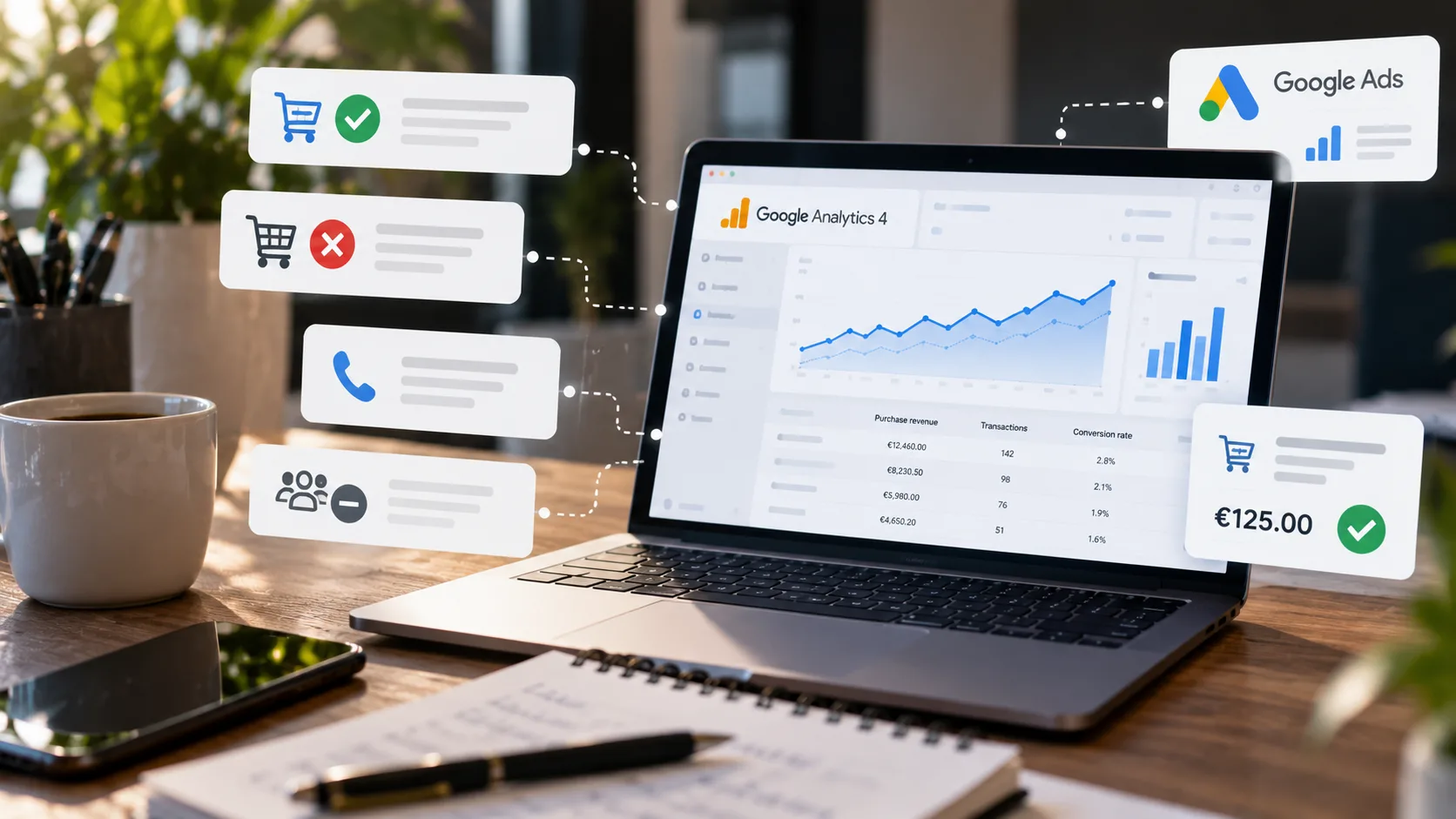
Most accounts we take over do not have a strategy problem. They have a measurement problem: they measure something, just not the thing that pays the bills.
This matters more than ever, because Google Ads campaigns now optimise themselves. Smart bidding strategies learn from the conversions you feed them and chase more of the same. Feed them the wrong signal and they will deliver the wrong result very efficiently. Measurement is not a technical detail next to the campaign; it is the steering wheel.
The four usual mistakes
1Every visit to the "thank you" page counts
If the customer refreshes the confirmation page, two orders are recorded. A conversion must count once per transaction, with a unique identifier.
In practice this means sending the order number (transaction ID) with the conversion, so Google Ads discards duplicates. Without it, the account sees more sales than happened and "rewards" campaigns that do not deserve it.
2Micro-actions count as conversions
A click on the phone number, a view of the contact page, time on page. Useful as signals, disastrous as an optimisation goal: the algorithm will bring you whatever you ask for.
The answer is not to delete these measurements but to set them as secondary. You see them in reports, but bidding optimises only for the primary conversion: the order or the completed enquiry.
3No order value is sent
Without a value, Google cannot tell a €15 order from a €300 one. With a value, it can chase revenue instead of volume.
For businesses that do not sell online, such as services or removals, the value can be an estimate per enquiry type. A form for an office move and one for moving a single piece of furniture are not worth the same, and the account needs to know.
4Cancelled orders are not excluded
If 20% of orders are cancelled, the account sees a picture 20% rosier than reality. Conversions imported from the ERP solve this.
Google Ads accepts conversion adjustments: a cancelled order is retracted, a partial refund lowers the value. The account then learns from orders that were actually paid, not from carts that were checked out.
Consent and accuracy: Consent Mode
In Europe you cannot track anyone who has not consented to cookies. Google's Consent Mode v2 is how you respect the visitor's choice without blinding the account: the tags know what is allowed and Google fills the gaps with modelling. Since 2024 it is effectively required for anyone advertising to users in the EEA. A cookie banner that is not properly connected to Consent Mode means either unlawful tracking or no tracking at all.
On top of that, Enhanced Conversions securely send hashed details such as the order email, so Google can match conversions to clicks better, especially when the customer switched devices.
What we check before we start
- One "Purchase" conversion with value and currency, counted once per transaction.
- GA4 linked to Google Ads, with figures that agree within a reasonable margin.
- Exclusions for internal traffic, test orders and staff.
- Call tracking, if the phone is an important sales channel.
- Cancellation imports from the ERP, so the account sees clean orders.
- Consent Mode v2 connected to the cookie banner, with correct defaults before consent.
Only once these hold does it make sense to talk about budgets and bidding strategies.
When the conversion is a phone call
For many local businesses the sale closes on the phone, not on the site. There we track calls from ads and taps on the phone number on mobile, and set a minimum call length so that someone who hung up after five seconds does not count as a customer. An example of Search campaigns aimed at phone calls is ArmyTransport, where customers call for a removal quote. Landing page speed matters here too: see what a slow site costs.
Who should set it up
Measurement touches both the site and the ad account. When two different people who do not talk to each other handle them, that is where the mistakes above are born. We set up both together, in our Google, TikTok and Meta campaigns. If you just want a second opinion on your account, see our consulting or write to us.
Frequently asked questions
Do I need both GA4 and the Google Ads tag?
Usually yes. GA4 shows you the overall picture of traffic from every channel. The Google Ads conversion tag gives campaigns the most accurate and fastest signal for optimisation.
Why don't GA4 and Google Ads figures match?
They count with different attribution rules, different time windows and a different date (click or conversion). A small gap is normal; a large one usually means double counting or a tag missing from some page.
What is Consent Mode v2, and is it mandatory?
It is the mechanism that tells Google's tags what the visitor has allowed. For ads to users in Europe, Google has effectively required it since 2024; otherwise features such as conversion tracking and remarketing are limited.
How soon do I see results once tracking is fixed?
The figures clean up immediately. Automated bidding strategies usually need a few weeks to adapt to the new, correct signal, which is why the fix comes before a budget increase, not together with it.