
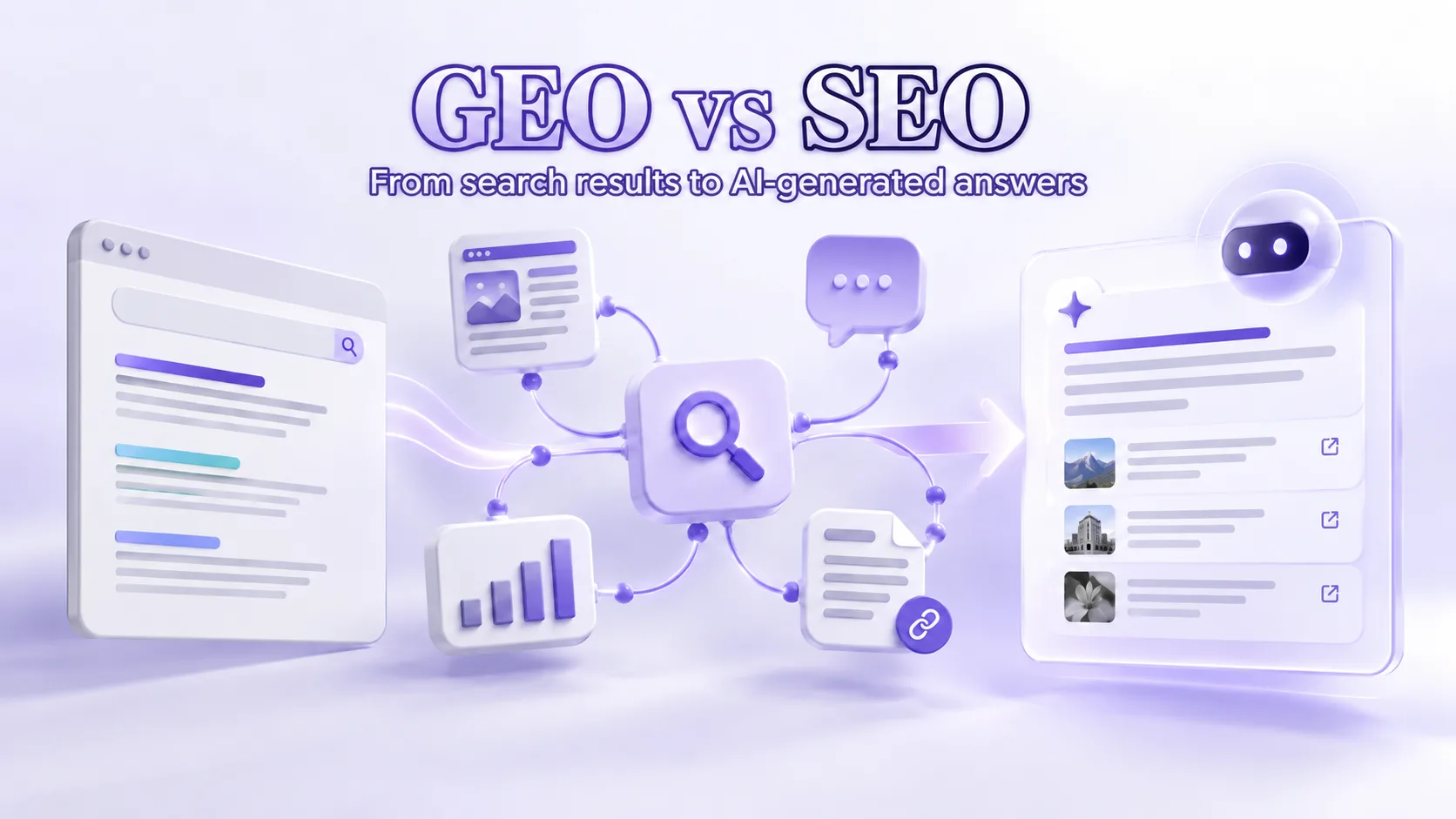
For twenty years the logic was simple: you climb Google's results, the user clicks, and they land on your site. In 2026 that chain is breaking. People increasingly ask an AI directly — and get the answer without ever seeing ten blue links.
The numbers show the scale of the shift. ChatGPT passed 800 million weekly active users in October 2025 and 900 million by February 2026. Google's AI Overviews reach more than 2 billion users a month. When that many people ask a machine that synthesises the answer instead of showing links, the question for every business changes: it is no longer only "how do I rank first on Google", but "how do I get cited by the AI when someone asks about my field".
That is exactly what GEO is for.
What Generative Engine Optimization is
GEO (Generative Engine Optimization) is optimising your content so that generative search engines — ChatGPT, Google AI Overviews, Gemini, Perplexity, Copilot — select, reference and cite it. Instead of chasing a position on the results page, the goal is to become the source the AI uses to build its answer.
The term is not a marketing buzzword; it comes from academic research. The paper "GEO: Generative Engine Optimization" (Princeton, Georgia Tech, Allen Institute for AI, IIT Delhi) introduced the framework and the GEO-bench benchmark of roughly 10,000 queries, proving that targeted content changes raise visibility in AI engines by 22% to 41%.
GEO vs SEO: what's the difference
They are not rivals — GEO builds on SEO. But the goal shifts:
SEOGEOGoalRank in the organic resultsGet cited inside the AI answerUnit of successPosition & clickCitation of the sourceAudienceThe user who clicksThe model that composes the answerMetricRankings, CTR, trafficShare of voice in AI answers
AEO (Answer Engine Optimization) is essentially the same idea with an emphasis on answers — many people use the terms GEO and AEO interchangeably.
What the research says works
The most useful finding of the Princeton study is that it separated what actually raises citations from what does not:
Quotations, statistics and citations raise visibility by up to ~40%. A page in position 5 could reach up to 115% higher visibility by adding credible sources.
Clear, authoritative answers to specific questions outperform generic text.
Keyword stuffing does not work — on some engines (Perplexity) it even made the content worse.
In other words: AI rewards content with substance, structure and evidence — not tricks.
How to do GEO in practice
Answer real questions. Build content around how people actually ask ("what is…", "how much does… cost", "how do I choose…").
Add evidence. Statistics with a source, numbers, expert quotes. This is the number one signal for AI.
Clean structure. Clear headings, short paragraphs, tables, FAQs — anything a machine reads easily.
Structured data (schema). Help the engines understand what your content is.
Authority & consistency. The same, correct message about your business across the web — the engines cross-check.
Measure your presence in AI. Ask ChatGPT, Gemini and Perplexity about your field and see whether —and how— they mention you.
Why now is the moment for Greek businesses
In the Greek market, GEO is still almost uncharted. It is the classic case where the first brand to invest gains an advantage that is hard to lose: once an AI "learns" to treat you as a credible source for your field, it keeps citing you. While competitors wait for the technology to "settle", the window closes.
At Adamit we see GEO as the natural continuation of SEO: the same quality principles, a new destination. From technical optimisation and structured data to content the engines trust, we help your business show up where people now ask — in the AI's answers.
Frequently asked questions
What is GEO?
GEO (Generative Engine Optimization) is optimising your content so that AI engines, such as ChatGPT and Google's AI Overviews, reference and cite it.
Does GEO replace SEO?
No. GEO builds on SEO and shares the same quality principles. The goal shifts: from ranking in the results to being cited inside the AI's answer.
How do I see if AI mentions me?
Ask ChatGPT, Gemini or Perplexity the questions a customer would ask, and see whether they cite you as a source and in what words.
Conclusion
Search is changing form, not importance. Any business that becomes a credible source for AI engines now builds an advantage that lasts. GEO is how you get there first.