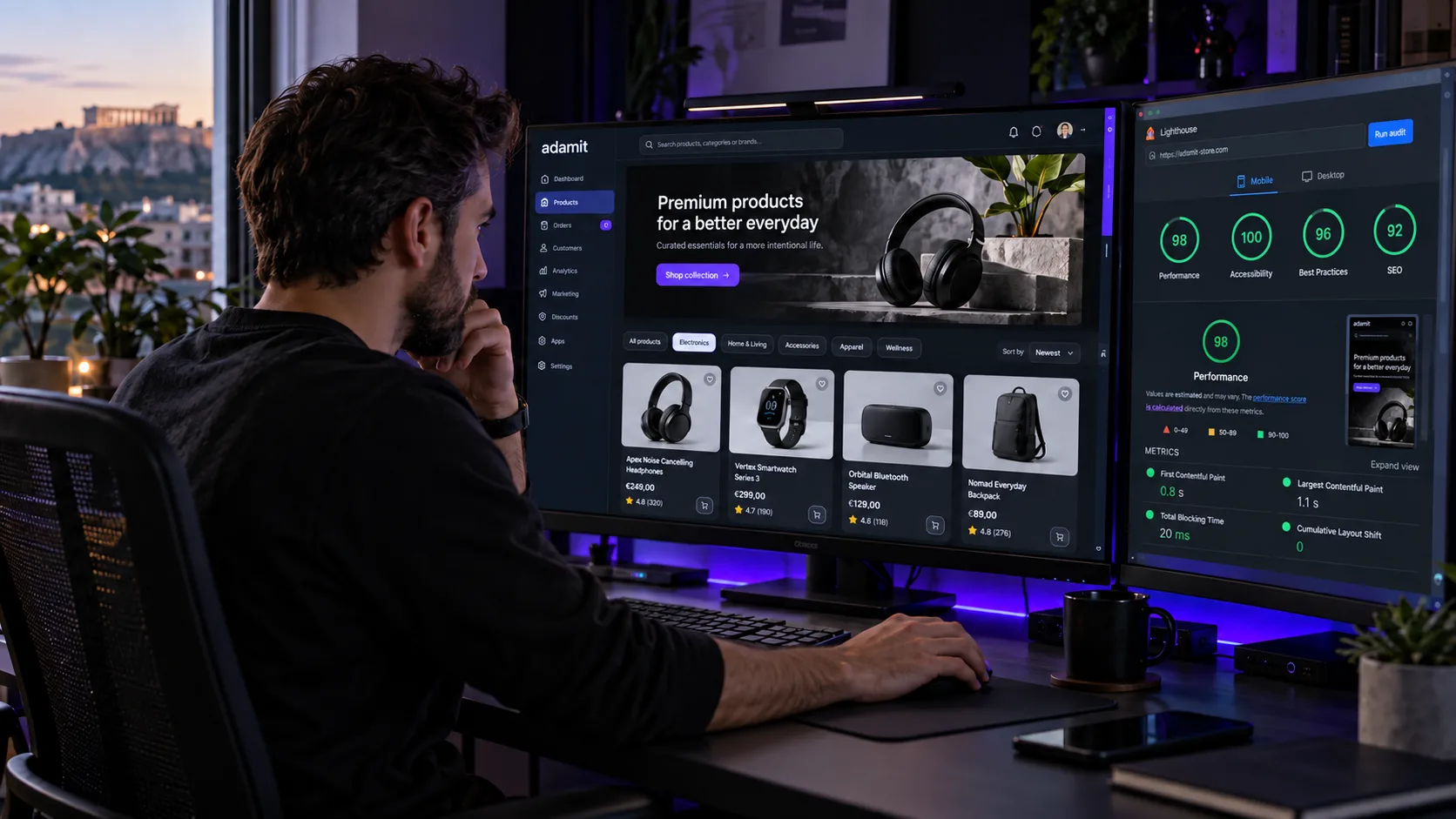

The choice is usually presented as a dilemma: either a cheap site on a ready-made theme, or an expensive custom one your budget "cannot carry". It is a false dilemma. We build a custom theme tailored to your business, at the cost you would pay anyway for a site on a ready-made theme. Here is why that is possible, and why a theme built for you earns more than one built for a thousand.
Built for a thousand, or built for you
A popular marketplace theme has to sell to the hotel, the law firm and the clothing shop at once, so it carries everything: ten demo layouts, mega menus, sliders, a portfolio, its own layout system and a page builder on top. You will use maybe 20% of it. The other 80% does not disappear because you never touch it; it stays in the code, loads in the customer's browser and needs updating as if you used it. A custom theme is the opposite: only what your business needs exists. No slider means no slider code to download, break or patch; the checkout flow and product page are designed around how your customer actually buys, not around a demo.
"Cheap ready-made" is rarely cheap
The price you see up front for a ready-made theme site is not the price you pay; it is the deposit. Add what comes afterwards and the picture changes:
- A page-builder subscription that renews every year, for as long as the site lives.
- Plugin licences, shipping rules, filters, integrations, many of them yearly rather than one-off.
- Speed remediation: the ready-made theme ships heavy, so you pay again for optimization a clean theme never needed.
- Maintenance hours: every update on a twenty-plugin site is a risk, and the time to test it costs money.
Add it up over two years and the "cheap" site reaches the budget that could have bought you a custom from the start. The difference is that with custom the money went into something that is yours, once, instead of subscriptions that leave every year.
Speed is not a luxury, it is revenue
Slowness never shows up as an expense; it shows up as lost orders, and the numbers have been steady for years:
- Deloitte and Google ("Milliseconds Make Millions", 2020, 30+ million mobile sessions) found that a mere 0.1-second load-time improvement was associated with about 8.4% higher retail conversions and about 9.2% higher average order value.
- Vodafone, in a controlled A/B test published by Google on web.dev, improved LCP by 31% and saw 8% more sales, a 15% better lead rate and an 11% better cart rate.
- An earlier Google analysis found that 53% of mobile visits are abandoned when a page takes longer than 3 seconds to load.
These are correlations, not a law, and the exact metrics have moved on since. The direction has not: every second you save, the customer repays with one more order. A clean custom theme starts from a lighter baseline, it is not "optimized" fast after the fact, it is fast from the start. The same is true for Google: since 2021 Core Web Vitals are part of the "page experience" signal, not the biggest factor (relevance matters far more), but Google's own team has said a site moving from "needs improvement" to "good" can benefit.
Why not load code you do not need
Page builders (Elementor, Divi and the like) solve a real problem: they let a non-technical person build layouts without code. That convenience is not free. They add measurable weight, extra CSS and JavaScript on every page, more database queries per load, and layers of HTML wrapped around your content. Even with their optimizations on, a builder-made page generally downloads more than a page that produces the same result on a clean theme. On a custom theme you pay for the design once and carry neither the builder nor its subscription, and you still get the same thing: a page that is easy to change.
"Without builders" does not mean "without touching the site". WordPress already has its own editor (Gutenberg) and structured fields (ACF): text, images, products, prices and banners all change from the admin, with no code touched. You edit content inside a fixed design instead of rebuilding the layout every time, which is where a site usually breaks.
Security: less code, fewer doors
Here the difference is measurable. Patchstack's "State of WordPress Security" report for 2024 found that of nearly 8,000 new vulnerabilities in the WordPress ecosystem, 96% were in plugins, 4% in themes and only seven in WordPress core itself; roughly 43% could be exploited without even logging in. Every plugin and every unused slice of theme you install is one more door to keep locked forever. A ready-made theme that ships with ten bundled plugins "to make the demos work" multiplies those doors from day one. A custom theme keeps the list as short as possible: a plugin goes in only when it solves a real problem.
Staying secure over time is a habit, not a state: fewer plugins kept updated, updates tested on staging before they go live rather than applied blind, one properly configured security plugin, and backups you have actually restored at least once.
How we keep custom at ready-made cost
The answer is not that we work for free. It is that we do not start from zero every time. We have our own, tested foundation: a clean theme core, ready integrations for payments and couriers, a proper SEO structure and the parts every Greek store needs. On top of that foundation we build only what is yours, the design, the buying flow, the quirks of your catalogue.
So you get a theme built for you, without paying for the hours of a theme written line by line from scratch, and without perpetual builder subscriptions. The result sits in the price range of a good ready-made theme site, only it is lighter, faster and genuinely yours.
What to ask before you sign
Whichever partner you choose, get a written answer to four things: how many plugins will run and who pays their licences in year two; whether the theme carries a builder subscription or not; who owns the code, the domain and the data; and whether there is a staging site to test changes before they go live. Those answers separate a store that is truly yours, and cheap over its life rather than only at the deposit, from one that is merely shown to you cheap at the start.